Your trades.Your agents.Your rules.
Kairos turns your trading journal into a local Obsidian vault: every trade with its thesis, its PnL, your psychology and what you did right or wrong. A team of AI models (Claude, GPT, Gemini, Astra and Grok) learns from it together and trades on paper. They only move to real money once they beat the marks you set. Kairos is the Greek god of the right moment: the agents wait for it instead of trading all the time.
WORKS WITH
Markdown notes on your disk, seven AI models working as one team, and brokers in paper mode; real money comes last
Your best strategy is already written in your trades: the ones you won and, above all, the ones you lost. Every trade becomes a note, notes become patterns, and patterns become agents that have to prove themselves on paper before they touch a dollar.
OF YOUR NOTES ON YOUR DISK
The vault is a folder of Markdown. Open it in Obsidian, copy it or delete it whenever you like.
PAPER TRADES, AT LEAST
A default example. You decide how many trades an agent must make before it is evaluated.
TRIAL DAYS, AT LEAST
One good week is not enough. The agent has to hold up across different markets.
REAL DOLLARS WITHOUT YOUR OK
Beating the marks only opens the door. You confirm the move to real money.
A journal your agents can read.
Every trade is a note with the same template: data on top, your reasoning below. What a spreadsheet loses (the thesis, the fear, the rule you broke) stays written and linked here.
Seven models. As a team, or solo.
Your choice: in Team mode the models split the work and check each other; in Solo mode one model of your choice does everything. Opus 5.5 leads the analysis, Sonnet 5.5 keeps the journal, Fable 5.1 watches your psychology, Gemini and Grok bring context and sentiment, Astra reads the charts and GPT gives a second opinion on every trade.
No leaderboard. Each model takes the job it does best and hands its work to the next.
In Team mode one proposes and a different one reviews it. No agreement, no order. In Solo mode, Brake still checks every order.
Models only see the notes a task needs, and every decision is saved with what the models answered, step by step.
Your risk limits are enforced by plain rules, never left to an AI's judgement.
From paper to real money, on your marks.
Pick a case. The evaluator checks the strategy against the marks you set and decides whether it may ask for real capital. Figures are an example of a strategy the team ran for 30 days on paper.
ON PAPER
The team trades a simulated balanceSame market, same orders, no real money.
LIVE
Already promotedThe team trades the capital you assigned, and is still evaluated every day.
YOU
Set marks and approveNo agent goes live without your explicit confirmation.
Rules you set once, and the system keeps.
Marks and limits live in a file in your vault, not on a server. Agents read them but cannot change them: only you can edit them.
A trial period that counts
Before evaluation, the agent must complete a minimum number of days and paper trades. No shortcuts, even after a spectacular start.
A drawdown that is not negotiable
You set how far the agent's account may fall from its peak. Cross it and the agent pauses instantly, on paper or live.
Only what the strategy allows
Each agent trades the assets, hours and sizes in its strategy note. An order outside it is blocked before it is sent.
Capital in tiers
The first real money is small ($250 by default). It keeps being evaluated every day with real money; raising it is your decision, never the agent's.
A daily loss limit
If the agent hits the day's max loss, it stops trading until tomorrow. Your vault's anti-tilt rule, applied to a machine.
Two models agree, or nothing happens
In Team mode, every trade one model proposes is reviewed by a different model against your vault. Both notes link to the trades of yours that justify it.
The switch is yours
Taking an agent live is a manual confirmation from you. Sending it back to paper or shutting it down is one click, any time.
Keys without withdrawal rights
Agents use broker keys that can only trade. They cannot take money out or move it to another account, even if they tried.
A log that stays
Every order, every pause and every promotion is written to the vault with a time and a reason. What happened stays on your disk, not in someone else's dashboard.
What an agent can never do.
Automation usually means handing over the keys. Here agents read, learn and trade inside a box you draw, and the move to real money always goes through you.
Change your marks
The rules file is read-only for agents. If an agent wants different marks, it proposes them in a note and you decide.
Withdraw or move money
Broker keys can only trade. No agent can withdraw funds or transfer them to another account.
Go live on its own
Beating the marks only puts the agent on hold. Until you confirm, it stays on paper.
Hide a trade
Every order is written to the vault before it is sent. If it is not in your journal, it did not happen.
From a note to a live account.
Four stages, the same for one strategy or ten, run by the same team.
Write down your trades
Use the vault template: asset, entry, stop, exit, PnL, thesis, how you felt and what you would do differently. Or start from the example journal: two years of trades from Kairos's own paper tracks.
The team reads you
Opus finds where you win and lose, Fable spots your psychology patterns, Gemini and Grok add the market around you. GPT challenges every idea before it becomes a strategy.
They prove it on paper
Each agent trades a simulated balance for the period you set. Brake enforces your limits and everything is written to the vault.
They beat the marks, you decide
If it meets your marks, the agent asks you for a first capital tier. You approve, and it keeps being evaluated every day with real money.
We ran the agent before asking you to.
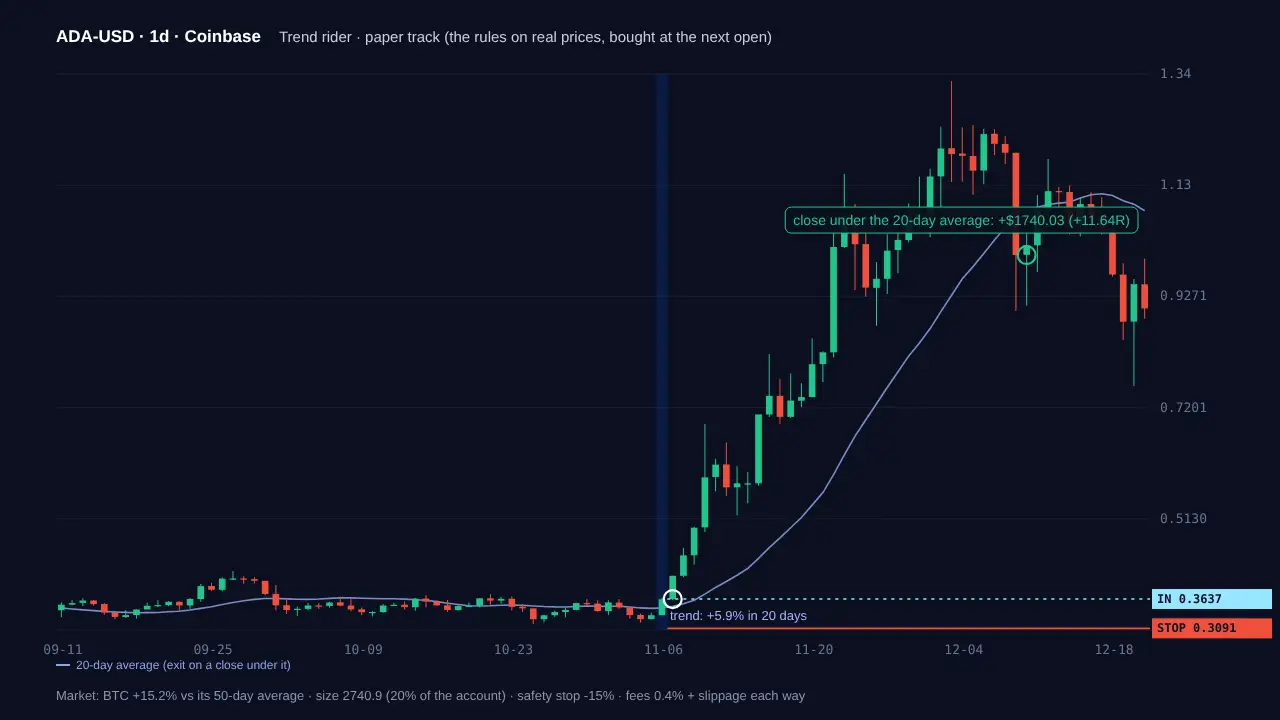
Ten paper tests on real Coinbase candles, with the app's own engine, Brake and Kraken-level fees. In runs 1 to 4 Claude Opus 5.5 made every decision; runs 5 to 10 are exact rules. Every run only saw the candles up to that moment. Each run left lessons, and the next run applied them on days it had never seen. Run 3 moved to memecoins, run 4 finally traded, run 5 tested the rules over a whole year, runs 6 and 7 tried cheaper fills and a slower strategy on data no run had seen, run 8 retried run 7 with a 12% drawdown limit. Run 9 buys sharp dips (it wins 3 trades in 4, small wins) and run 10 rides trends (it wins 1 in 3, big wins); run half and half, they are the first to make money on years no rule was tuned on. Their paper tracks fill the example journal and keep going every day. Neither has traded real money yet
+54.7% in the last 2 years


Loses often, wins big
Wins 3 trades in 4
8 decisions, 1 trade
8 decisions, 0 trades
8 decisions, 0 trades

10 decisions, 2 trades
29 trades, not ready
37 trades, not ready
Stopped every year
Still stopped every year
Long ETHLong ETH: close above a 2.6-day base. 2.0195 ETH (~$4,632), $100 at risk. Stopped at 17h: −$138.91 (−1.39R).Long SOLClose above the 5-day high (104.90) on 2.4× volume. Entry 106.37, stop 102.40, target 116.20, 25.17 SOL (~$2,677), $100 at risk.Long BTCClose above the 3-day range top (81,925) at 08:00 on 3.8× volume, then 4.3×. Entry 84,678, stop 81,600, target 92,200, 0.0326 BTC (~$2,760).Trade with the market
Run 9 only buys dips while BTC is above its 200-day average: in 2022 that kept it out of the crash completely, while run 10, which trends faster, lost 37%.
Two edges beat one
Dip buying wins often and small; trend following loses often and wins big. Half and half, the worst drop over the last two years fell from 37% to 24%.
Volume or nothing
Run 1's loss was a wide candle on weekend volume (0.5×). In run 2, the same filter skipped a false ETH breakdown that would have lost.
Fees change the math
0.4% each side took 39% of the planned risk on a 2.1% stop, so a 1R stop really cost 1.39R. The fix: stops of 3% or more and targets of 2.5R or more.
Decide often, never chase
Deciding every 20h missed a clean BTC breakdown. Run 2 decided every 12h, and the app checks every 60 minutes by default.
Too strict misses winners
Runs 2 and 3 avoided every trap but made no trades, and zero trades means zero progress toward the marks. Run 4's rule: when a setup meets the rules, take it, without stacking extra conditions on top.
Crashes come in steps
The 8 Oct memecoin crash fell about 4% over 25 minutes and never 3% in any 3 minutes, so a 3-minute alarm would have stayed silent. The shock detector now also watches 15-minute windows.
The gate works
Run 5 lost on months it had never seen, and Brake stopped it twice at the 8% drawdown limit. That's the point: a strategy that can't beat the marks on paper never gets near your money.
Fees decide it
Before fees, the first half was profitable (profit factor 1.68). Kraken-level fees of 0.4% each side took $295 and turned it into a loss. Breakouts with 3% stops need cheaper fills (maker orders) or fewer, bigger moves.
Cheaper fills aren't an edge
Limit orders cut the fees by about a third, but run 6 still ended with a profit factor of 1.09 on its unseen year. Saving on costs helps a strategy that already works; it can't create one.
Your limit, your call
Trend-following had a great 2024, yet every year 4 coins that move together dragged it to the 8% drawdown limit. A looser limit means bigger losses with real money, so only you can change it: run 8 tests 12%.
More room isn't an edge
At 12% the strategy simply lost more before Brake stopped it: three of four years still ended in a loss. The limit was doing its job; the strategy needs a better entry, not a looser leash.
Fifty trades is a high bar
No run reached 50 trades in a year without losing. Slow strategies trade too little; fast ones pay too much in fees. That's why the marks ask for it.
Don't strangle winners
Run 4 picked two good breakouts and still lost $14.90, because both stops were pulled up under the latest small dip. Left alone, they would have made about +$200. The new rule: only move a stop under a real swing low with room for normal noise, and not before +1.5R.
Runs 1 to 4 are a handful of AI decisions and prove nothing statistically; runs 5 to 10 test exact rules over whole years. Either way, the marks decide: no strategy gets real money before 50 paper trades over 30 days, a profit factor of 1.5 or more and a drawdown under your limit (25% now that you raised it for the portfolio; 12% until run 9, 8% until run 7). A profit factor is only shown once a strategy has both wins and losses, and a win rate only after 10 trades.
Memecoins, with a tighter leash.
Agents can paper trade memecoins and, once they pass your marks, trade them for real on Kraken. They get a preset strategy, Memecoin momentum, with its own rules: memecoins move 5% on a tweet, so they get smaller sizes and a higher bar to enter.
Tradable on Kraken
DOGE SHIBPEPE
 BONKWIF
 FLOKI
 TRUMP
 PENGU
 POPCAT
Only coins listed on Kraken with real volume and a tight spread. No fresh DEX launches or tokens bought from a contract address: they can't be stopped out on an exchange, and that is where most rug pulls happen.
Argus sees the news in seconds.
Argus, named after the giant with a hundred eyes who never slept, is the watcher inside Kairos. Every 30 seconds it reads the fastest free crypto feeds and the 1-minute candles of every coin your agents watch. A big move on heavy volume makes running strategies decide right away, and Brake blocks new entries on that coin for 15 minutes so nobody chases the candle.
Where news comes from
- Tree of Alpha: tweets and headlinesseconds
- X API, with your own key60 s
- Cointelegraph, The Block2 min
- Your forwarded alertsinstant
Price, not just headlines
A move past 4× the coin's normal volatility in 3 minutes, or a slower cascade over 15 minutes on 2.5× volume. Often the price moves before any headline exists.
Decide now, don't chase
Running strategies on that coin decide immediately, with the headlines and the shock in their prompt. Brake's shock guard blocks new entries for 15 minutes, unless a strategy is built for momentum.
Bring your own tracker
Anything that can call a URL can feed the agents: j7tracker alerts forwarded through Telegram or Discord, TradingView alerts, n8n or Zapier. Each request needs your private token.
Replayed on real 1-minute candles, the detector flagged DOGE, PEPE and WIF 20 to 23 minutes into a −4% cascade, and they fell another 3 to 5.5% after the alert. No tool reliably sees a crash before it starts. The realistic goal is to know within seconds, and to stop the agents from chasing the candle.
Models that check each other's work.
No leaderboard and no winner-takes-all. Each model does the job it is best at, and in Team mode every trade needs a second model to agree. Prefer one model? Switch to Solo. You choose which models are on.
Real money comes after the proof, not before.
It runs on your computer, next to your vault.
Open the web app on this site to try it in seconds: everything stays in your browser, and paper trading runs while the tab is open. Install the desktop app for paper trading around the clock, RSS and X news, and real money on Kraken: your journal and keys never leave your machine.
Free. macOS 11 or newer (Apple silicon and Intel), Windows 10 or newer, or Linux. No account, no terminal, nothing else to install.
Download
Click the button. The installer lands in your browser's downloads.
Open it
Mac: open the file and drag Kairos into Applications. Windows: open the file and it installs itself. Linux: open the AppImage.
Kairos opens
It starts on your desktop with the example journal and creates your vault, TradingVault in your home folder, ready for Obsidian.
The first time only: Kairos isn't signed with Apple or Microsoft yet, so your computer asks once. Mac: if it says it can't check the app, open System Settings → Privacy & Security and click Open Anyway. Windows: click More info, then Run anyway. Developers can also run it from source.